Thursday, January 31, 2013

TBT - Heard it at the Pizza Parties!

We were so happy to see so many great people in St. Louis and Minneapolis this year at our Pizza Parties! At both of these Camp Foley get togethers, we asked those who attended to share some things with us.

What is your favorite memory from 2012:

"Making up sailing songs with Natalie Cooper & Meghan O’Connell." – Kieran O’Connell, St. Louis

"Waterskiing." - Anna Krummenacher

"Sailing, also treehouses, waterskiing." - Annie Epstein

"Treehouses." - Kate Krummenacher

"Sailing, treehouses and dancing in our cabin to ‘Chasing the Sun’" - Claire Krummenacher

"My favorite memory was our last cabin activity, and we stole one of the boats to take out on the lake. After awhile we stopped, and anchored down, and started jumping off the boat while saying or attempting to make the sounds of the animal a person said. It was fun and a good last memory." - Molly Bauer

Twin Cities Pizza Party
"Shooting a rifle for the first time."

"Playing with friends."

"I liked when i got up on skis."

"Double skiing with Sophie Corniea and MC!"

"The banquet."

"Windsurfing."

"Waterskiing." 

"My favorite memory of Camp Foley is the nice campfires and bonfires." - Emily Jurgens

St. Louis Pizza Party
What are you most excited about for 2013:

"Seeing all my friends and new activities." - Anna Krummenacher

"Sailing! Also seeing friends again." - Annie Epstein 

"Seeing all my FRIENDS!" - Kate Krummenacher
 
"Getting my American Archer."

"Attending camp for the first time!" 

"Summer!"

"Food."

Lastly, we asked people to share what words come to mind when they think about Camp Foley: Fun, Cool, Awesome, Playful, Sunny, Exciting, Delightful, Tiring, Great.

If we didn't have a Pizza Party in your area, or if you couldn't attend in St. Louis or Minneapolis, share you memories with us anyway in the comments below, on Facebook, on Twitter (@campfoley) or by email (fun@campfoley.com)! We're always excited to hear from our Foley friends!

Monday, January 28, 2013

Camp Creature - The Common Snipe

-->
The Common Snipe
Is it possible to meld a Throwback Thursday and Camp Creature blog into one?  Well in this segment of the Rattlin’ Bog we are certainly going to try.  Who remembers going on a Snipe Hunt?  I would guess it is likely the “older” generation of campers that do.  Regardless, this mythical creature is the source of one of the greatest evening programs to ever take place at Camp Foley. 

A Snipe Hunt, for those of you who have no clue what I’m talking about, goes something like this:  Young campers are told by their counselors to dress up in the crazy clothes they own and are promptly marched from their cabins.  Upon arriving in some obscure knoll of the Camp Foley woods, counselors animatedly tell their campers they are here to try and catch a snipe.  Old potato sacks are then handed to the kids and soon the woods are filled with the screams and laughter of campers and counselors as everyone attempts to call, and ultimately, catch a snipe.  However, very few groups are successful in even seeing a snipe, let alone catching one.  Those who are fortunate enough to have spotted a snipe give wide and varying descriptions of this creature.  This is because the snipe appears differently to every individual fortunate enough to behold this remarkable creature.

I am sure many of you are thinking to yourself, “But wait a minute… Snipe aren’t actually a real thing.”  But that my friends, is where you are wrong. 

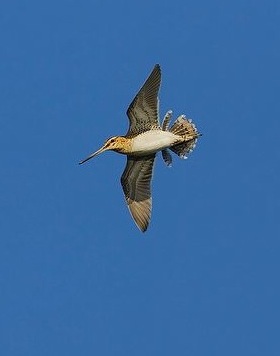
Meet Gallinago gallinago, the Common Snipe. This 6 to 8 ounce bird measures only about 10 total inches from end to end.  Even when including the snipe’s 2 inch bill!  The Common Snipe most closely resembles an ocean shorebird, such as a sandpiper.  The snipe has long legs and small, pointed wings to go along with its long bill.  Usually consisting of a striped grey-brown plumage, the snipe is most readily identified by its very erratic flight pattern, which is composed of many twists, dives, and turns.  It is these characteristics that give rise to the wide and varying descriptions of the snipe! 

Like shorebirds, the Common Snipe spends most of its life on the ground.  Its preferred habitats include heavily wooded forests and wet meadows.  Instead of eating small oceanic creatures like the shorebird, snipe probe the wet earth for a variety of worms, grubs, and even insect larvae.  The primary feeding hours for the snipe occur at dawn and dusk.  This is why Snipe Hunts always occur during evening program!  Additionally, snipe also roost and lay their eggs on ground level nests.  Snipe usually lay four very developed eggs, which hatch in only three weeks.

The Common Snipe is a migratory bird.  When the first frost begins to creep down into Minnesota, the Common Snipe begins its migration to the Southern states.   The snipe will spend the winter months there before returning to its summer home. 

So the next time your counselors tell you and your cabinmates you’re going on a Snipe Hunt, don’t roll your eyes and claim there exists no such creature.  You may be asking, but why would anyone want to go through all of that work to catch a small bird?  Quite simply, Marie, the director of Camp Foley, loves Snipe Pie.  She has even been overheard saying she would pay a hefty sum of canteens to the first cabin to catch a snipe or two so she can make her beloved Snipe Pie!  

For more information on the Common Snipe, visit the DNR website.

Thursday, January 24, 2013

Throwback Thursday: 2012 Octos


For this Throwback Thursday post, I reached out to some of the 2012 Octos. I asked them to answer two questions: What was your favorite part about being an Octo, and what did you learn from the experience? But first... let's get some facts about the Octo program. I asked Alli to give me the lowdown on the Octo program, and here is what she said:

When did it started? 2010 as the final step in the Foley leadership program.
What is it? "It is a two week volunteer program where participants live in a cabin of younger campers and during the daytime, help in the kitchen and serve as assistants at specific activities."
Why the name? "The 'Octo' name comes from the similarities between the program and the ocean creature of the same name. Octopus are known for their ability to be flexible, blend in with their surroundings, squeeze unnoticed into the small spaces of the ocean, and for their eight arms, each with the ability to juggle different things. The most important characteristic of an octopus is their dedication to their "kids." ... Just like their namesake, the Octo Interns are 100% dedicated to the younger campers, the overall camp program and their development as a leader!"

Kadigomeg, Second Session 2012
Tate Spencer was a camper from 2002 to 2011 (ten years) during the second half of the summer. In 2012, Tate was an Octo during Second Session in cabin Kadigomeg.
“My favorite part about being an Octo was being able to essentially have the best of both worlds. I was able to be a counselor while still being able to take all the activities I love such as wakeboarding.”
“I don't think it is possible to answer this question in a few sentences. I learned far too much while I was an Octo, but I think the most important thing I learned was how to stay positive. There are a lot of responsibilities that Octos have and it is very easy to let them stress you out and get the better of you. But I learned how to truly enjoy everything I did there and keep a smile on my face every day.”


Matoaka, fourth session 2012
Melissa Ferrie was a camper during Third Session for eight years and Third and Fourth for two years from 2002 to 2011. In 2012, Melissa was an Octo during Fourth Session in cabin Matoaka.
“I loved getting the chance to get a staff perspective and learning from the other counselors, while still getting to go sailing during my free hours. I also loved assisting activities and working with the campers every day. The kitchen work was hard, but it definitely paid off in the end.”
“As an Octo, I learned a lot about all of the little pieces that work together to make camp great. I felt so supported as an Octo. I also learned the real value of hard work and team work, and how much difference a positive attitude can make.”


Kildare, fourth session 2012
Stephen Davis came to camp in 2004 and spent eight summers during Third and Fourth Session at camp. In 2012, Stephen was an Octo during Fourth Session in cabin Kildare.
“[My favorite part of being an Octo was] just getting to chill with my cabin! My Kildare kids were awesome! They were so much fun to be with!”
“[I learned about having] more responsibility – not making sure I was having a good time but instead that everyone else was.”


Do you one day hope to be a part of the Octo Program? What would you be most excited about? Share you thoughts and memories with us for a TBT post in the comments or at Fun@CampFoley.com

Monday, January 21, 2013

Can You Canoe?


Perhaps one of the best ways to capture the serenity of any waterway in Northern Minnesota is by canoe.  The quietness of the canoe is what enables Camp Director Alli Faricy to snap all those cool pictures of the various camp critters.  Canoeing is also one of Marie Schmid’s, Director and Owner of Camp Foley, favorite pastimes.

Canoe with sail at Foley in the 1930s.
Canoeing was one of the first activities to be offered at Camp Foley.  It may have even been the first!  This is hardly surprising considering canoes have been around for thousands of years.  However, contrary to popular belief, canoes were not first used by the Native Americans.  The first canoes were used by the various natives of the Caribbean Islands.  These canoes were actually large tree trunks that were dugout, hollowed, and shaped.  This is actually where the word canoe originated from.  The Caribbean natives called their vessels “kenu”, meaning dugout.

These “kenus” would look nothing like the canoes we have at camp today; however,  the canoes created by the North American Indians would look almost exactly the same as the camp canoes.  That’s because the design of these original canoes have remained virtually unchanged since their creation. 

Birch bark canoe, 1908.
There is however one major difference in the materials that have been used to construct the canoe.  Today, canoes are largely made from aluminum or fiberglass and are welded together.  The original canoe was built with all natural material.  The ribs (just a fancy word for frame) of the canoe were made from branches, usually from a birch or pine tree.  The frame was held together with the root from a white pine.  Once the frame was fully constructed the canoe was covered with layers of birch bark. 

That’s right, birch bark!  Many of you probably remember using birch bark to help start campfires while out on various camp trips and were most likely told that birch is highly flammable because of its oily composition.  But this oil also makes birch bark very waterproof and quite durable.  Birch bark is also very lightweight which made it the perfect material to help a canoe quickly skim down streams and across lakes.  Birch bark is really a super product of nature!

Canoeing at Camp Foley, 2012.
Today the canoes at Camp Foley are made from aluminum.  Campers can sign up for Canoeing as an activity or go on a three-day canoe trip down the Crow Wing River.  Canoeing Instructors help guide campers through the Novice, Basic and Advanced Canoeing Awards as set down by the American Canoe Association.  These awards teach campers everything about canoeing, from the basic strokes and usage of a canoe, to how to sail a canoe with just two paddles and a poncho!

So the next time you have the desire to enjoy the peace and quiet that the waterways of Northern Minnesota a have to offer, sign up for Canoeing at camp, or better yet, go on a canoeing trip!              

For a more in depth history of canoeing check this out. 

Thursday, January 17, 2013

Thorwback Thursday: Sailing in the 70s with Rob Kugler


This TBT is a little different than what you're probably used to seeing! For this week, we have a great story from a Camp Foley alum from the 70s. If you're a Foley sailor, then this TBT is definitely for you! 

Name: Rob Kugler
From: Hastings, MN
Years at Camp: 1974-78
Family that has attended Camp Foley: Father (Joe) in the 40s and two children (Logan and Taylor) in the Mid-Late 2000s. 
Camp Memories: Canoe trips on the Pine River, early morning waterskiing with breakfast on the beach, sailing as a crew-member on the Checkmate, Capture the Flag, tetherball battles and Bob Schmid's (Marie's father) fun gentleness.

Rob Kugler, opening the trophy in 2012.
We heard from Rob Kugler's family in 2012 about tracking down an old Sailing Regatta Trophy that Rob won some time in the 70s (they wanted to surprise him with it for his birthday). We were able to track down the actual trophy that Rob and his friend, Alberto, received for a Regatta they participated in on Whitefish Lake. As Sailing is one of Camp Foley's most popular activities, we thought we'd have Rob recall the memory for us..

The regatta was a Whitefish Chain event that brought in sailors from all over the chain of lakes (Upper and Lower Whitefish, Cross and Rush).  I am not sure but I believe Camp Foley was the only camp that participated.  We had two entries, both in the small boat class.  Within that class there were 20-30 entrants, there was also a large boat class but I do not remember much about that category or who raced or prevailed.


Sailing at Camp Foley in the 70s.
I was assigned the “Johnson X” which at that point had a few years on her, was sturdy and a bit on the heavy side.  It was a great boat in a heavy wind.  Unfortunately the day dawned and it was a perfect Northern Minnesota summer day - soft blue sky, warm sun and virtually no breeze.  Perfect day for waterskiing but not sailing!  I hoped that as the day warmed a breeze would pick up but as it stood in the morning it was clear that I could only bring one of my two crewmembers.  I cannot remember how we decided (maybe a coin flip?) but Ted Kronschnabel was left on the shore and I ventured out with my remaining crewmember Alberto.  

I was very pessimistic as I reviewed our competition – tiny boats (Sunfish, Razor’s), light speedy boats (M-16’s) and a variety of boats from cabins around the lake all of which were smaller and lighter than the Johnson X.  At the start we managed to hit the line at the horn but that was our last sniff of the lead.  As we strategized our tacks and executed our turns, we were passed by many of the smaller and lighter boats (many of whom seem to mock us as they went by).  I still recall the frustration of doing everything we could to squeeze a little more speed from the old gal but still losing ground to the other boats.  Finally, we crossed the finish line, not in last but certainly far back in the pack.  

A bit disheartened, we pulled up on the beach that served as race headquarters and got out of the Johnson X.  It was at this point that Tom Schmid (my counselor, sailing instructor and race sensei) came up to us in a very excited state.  I supposed that he or another camp boat had done well.  Tom explained that despite where we had finished we had done very well and that the race employed a handicapping system that accounted for wind speed and boat weights to level the playing field regardless of the weather.  This was news to us!  He said we would need to wait around for the final race results announcement to see but he thought we might have snuck in with a “place” which would have made us very happy.  

Finally, the results were tabulated and the lead Regatta committee member began to read the small boat class results.  He started with the third place finisher and to our disappointment it was not the Johnson X.  Disappointed we shrugged at each other but we felt better knowing that Tom had thought we had done well.  The Second Place was announced and then came the first place announcement.  When the name the “Johnson X” was announced I remember being stunned for a few seconds then jumping and embracing with Alberto and then being told that I had to go accept the First Place trophy which I gladly did in front of a group of our competing sailors, family members and friends.  

The trophy: 1st Place, Rob Kugler, 1976.
I will never forget that moment, the sun, the lake, the sand, and the good natured applause from everyone on the beach.  That evening when we got back to Camp we had dinner under the pines outside the Dining Room and I was asked to get up and make and say a few words on the big victory for our Camp and the Johnson X.  When I was done everyone clapped and cheered again – another very big moment!


Over the years I have thought about that day many times and what it meant to a seventh grade kid to have success like that!  My family has heard this story many times – although I am not sure they believed it until they saw the Trophy!   I believe moments like that and the lessons learned from those moments help build a foundation that in some small way help direct a life.   This is just one of the many reasons that I sent my son Logan and my daughter Taylor to Camp Foley.

Do you, or does anyone you know, have any stories from camp that you'd like to share for Throwback Thursday? We'd love to hear from you! Just send an email to Fun@CampFoley.com. For other fun memories from the 70s, check out the old newsletters on the Foley website.

Thanks to Rob Kugler for sharing such an awesome memory with the Foley community!


Monday, January 14, 2013

Camp Creature - Common Loon


Photo: Alli Faricy
As the evening waves break across the shoreline of Whitefish Lake, a beautiful yet haunting sound can be heard echoing through the tall pine trees that guard the grounds of Camp Foley.  Again, the sound pierces through the silence: Woooo – oooooooo.  Along with the whine of mosquitoes, the calls of the Common Loon are the sounds most associated to summertime at Camp Foley and northern Minnesota.


Winter plumage
Minnesota’s state bird, the Common Loon is, dare I say, a common thing for campers to see while at any water activity.  In fact, Minnesota has more loons, roughly 12,000, than any other state besides Alaska.  The Common Loon is slightly larger than a Mallard Duck, and adults weigh between eight and 12 pounds.  They have a very long, thick neck with a long, black bill, which gives them an awkward appearance when flying.  Most campers and counselors would recognize the Common Loon because of its black and white speckled plumage (the layer of feathers that cover a bird and the pattern, color, and arrangement of those feathers) and of course, its red eyes.  But did you know the Common Loon replaces its “summer” plumage with a molted grey “winter” plumage?  It’s only fitting that the campers and counselors of Camp Foley get to see the Common Loon at the pinnacle of its beauty. 

Underwater fishing
The Common Loon spends the majority of its time on the water, only coming ashore to mate and incubate its eggs.  As a result, the Common Loon has many cool features to help it better adapt to its aquatic environments.   The Common Loon is a very agile swimmer; the loon’s feet are positioned farther back on its body than most birds.  Additionally, unlike most birds, loons have solid bones.  These two features allow the loon to swim underwater like a torpedo.  In fact, loons can swim down to depths of over 200 feet and hold their breath for over five minutes.
  
As many of you may know, it’s pretty dark deep down in Whitefish Lake.  It has been theorized that the red eyes of the Common Loon enable it to see better while underwater.  This helps the loon locate various species of fish, a staple of its diet.  However, any camper who has taken fishing at Camp Foley can tell you that fish are very slippery creatures.  The Common Loon has a beak that solves that problem.  The inside of the Common Loon’s beak is filled with rearward-pointing projections, best described as very small teeth.  This adaptation, along with the loon’s unique tongue, help the loon secure even the slipperiest of fish. 

Photo: Alli Faricy
These adaptations may be very beneficial to the Common Loon while on the water, but they make for very comical takeoffs.  Like airplanes, loons need a “runway” in order to takeoff and fly.  The Common Loon will begin “running” across the water while flapping its wings, in an attempt to build up enough speed for takeoff.  The loon needs a runway anywhere from 30 yards to a quarter-mile long in order to gain enough speed for a takeoff.  Once in the air however, the Common Loon can fly pretty fast.  Migrating loons are estimated to travel at speeds of over 70 miles per hour while on their way to the Gulf of Mexico, where they spend the winter months.

Camp Foley is committed to helping the Common Loon thrive.  During the summer of 2012, both groups of CIT’s donated their time and helped the Minnesota DNR (Department of Natural Resources) obtain a rough population count of the Common Loons living on Lower Whitefish Lake.  Additionally, Loon Calling was an optional sixth period activity, which was dedicated to teaching the Wolf campers about the life and various calls of the Common Loon.