Showing posts with label snapping turtle. Show all posts

Wednesday, December 30, 2020

The History of Camp Pets!

Either Yogi or Kayzak...
How much do you love camp's dogs, Nike and Norm? I mean... they are playful, adorable and always provide some entertainment when they are around. Not surprisingly, Nike and Norm are not the first "camp pets." We thought we'd go back to the mid-70s and give you a little detail on the camp pets that we've had over the years.

In 1974, Tom Schmid (Marie's brother) got a dog for Christmas, who was named Yogi, and a few summers later, Kayzak joined the crew to accompany Yogi. Both Yogi and Kayzak were beloved by the campers and staff.


Buckley!
Flash forward 20years and camp has a new creature roaming the property - a fawn! Buckley the deer spent his first summer at Foley in 1996. Buckley was known to make appearances in the winter as local residents of Father Foley Drive have shared memories of Buckley following them around as they cross country skied on Whitefish Lake. Buckley spent a few years hanging around the area before moving on. It makes me wonder if there are any of Buckley's descendants roaming the woods behind the soccer field.


Casual Sheep outside the office.
Four-legged creatures aren't the only kinds of pets camp has. In the late 90s Foley was home to two birds: Ka-Kaik, a Red Tailed Hawk, and May-Goo, a Great Horned Owl. Both birds left in 1998, but for a few summers they were quite exciting. They lived in cages outside the wheelhouse. I know some alumni remember sitting around them for bird shows. What a fun learning experience! We also had a Boa Constrictor in 2000, named Taz! I wonder if he lived in the Nature Center with the other snakes?

Apparently we had some new four-legged friends in the late 1990s and early 2000s. While doing some research I found the following quote, "Sheep enclosure - Baaaaad idea." Not quite sure what to make of that but I'm sure if you ask Marie she'll give you the scoop! A few other creatures that you may not have expected to see at camp: Smiley, the alligator, and Stella, the hedgehog.

Stella the hedgehog.
Of course there are the old standbys that you can always expect to see at camp: all of the snakes inside the Nature Center along with some turtles in the enclosure outside. Hopefully the new Painted Turtle and Snapping Turtle, Muncher and Bowser, live a long and happy life at Camp Foley, or the surrounding area, just like Woody the Wood Turtle, who passed away in 2007.

What do you think about all of the camp pets Foley has had? Do you remember any other camp pets? One thing is for sure - I am willing to bet that the next 35 years will bring a variety of new animals to camp, even if they only stay a short time! 


Thursday, March 21, 2019

Camp Creature: Top 5 Highlight Reel!


One of our favorite things to post about is our featured Camp Creature. We have tons of camp creatures here living in this part of rural Minnesota, which puts us in an excellent spot to explore and see animals of all types. Today we are bringing together some of your favorite editions of Camp Creatures past to bring you ..... the Camp Creature Highlight Reel! You might remember some of these blog posts, and for those of us who do not, we are reminded of all the nature that we're connected to here at Foley:


Coming in at Number 5: The Bobcat
More than likely, we won't catch a glimpse of these elusive creatures, but they are local to the area. A fun fact about the bobcat is that it gets its name from its 'bobbed' tail which looks as though it has been cut off. Check this blog out to learn more fun facts about the bobcat!


Next, at Number 4: The Common Snipe
This small brownish bird is also sometimes called the 'Jacksnipe' and can be found in Minnesota especially near wetlands and damp forests to help them probe for food in the soft ground. Ever wanted to learn more about snipe hunts? Well here's your chance!


At Number 3: The Beaver
Photo by Alli Faricy at Hidden Lake
What's cooler than being the largest rodent in North America? What about having webbed feet? Wait, you mean to tell me that beavers are the largest rodent in North America and have webbed feet? How neat is that! Raise your hand if you've seen one of these creatures around Hidden Lake. We think it's pretty neat having the beaver as our neighbor on the lake, and we've got a lot more interesting facts about them here!
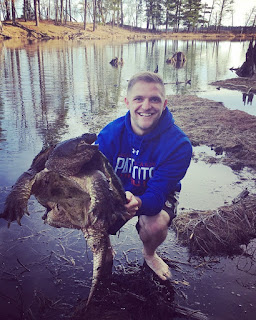


Our Boys' AD, Jordan, with a massive snapping turtle


In the Number 2 Spot: The Snapping Turtle
If you've taken Nature as an activity, come to our Outdoor Education program, had the chance to paddle to Hidden Lake, or driven down the road then you may have had the experience of seeing a snapping turtle. This is the largest turtle in Minnesota, some even reaching 80+ pounds! Check this blog out for even more cool things about snapping turtles.


And finally, at NUMBER 1: The Bald Eagle
The numbers don't lie - this blog post is one of our most popular to date! These majestic birds are stunning mid-flight, and more than likely, you've seen at least one during your time here at Foley (if not, just take a moment in the quieter hours of the day to look out over the lake and up in the trees). Our Director, Alli Faricy, has been known to take stellar shots of these birds of prey as they soar around Whitefish Lake. Check out our top blog to learn more and check out her amazing photos!
Photo by Alli Faricy
Photo by Alli Faricy, an eagle perched with its prey


Photo by Alli Faricy, an eagle mid-flight with a fish in its talons


Well, that just about covers it - our TOP FIVE camp creature posts to date. Comment below and let us know what Camp Creatures you'd like to see featured on the Rattlin' Blog!

Oops, and we almost forgot!
For Honorable Mention: Camp Dogs 

They may not be too wild, but we can't just leave out three of our best camp creature buddies. Remember throughout the summer to stop and say hi to our furry friends who continually travel around camp!

Tuesday, December 4, 2012

Camp Creature – The Minnesota Snapping Turtle

Crikey! She's a keeper.


Today’s Camp Creature story is about a young Minnesota Snapping Turtle, who lived in the Camp office in 2012 and 2013.  It was found in the summer of 2012 down by the marina docks by Peter Beltz, a camp counselor.  We asked for help naming this fella, and the winning name was Bowser. Bowser lived up to his name, and got more "snappy" as he grew. Now he has been in the wild for the past 3 summers. Bowser is likely "dinner plate" sized and just loving the pond life. Let's refresh our knowledge on Snapping Turtles! 

What’s this creature all about?  The Snapping Turtle, or “Snapper,” is Minnesota’s largest turtle.  Most are brown, black or olive grey in color, have sharp clawed feet, and feature small spike-like ridges on the top of their shells.  Snapping turtles can live 30 years in the wild and typically grow to about nine to fourteen inches in size across the top of their shells.  In captivity they can live 47 years and weigh up to 86 pounds!  The largest snapping turtle ever found in the state measured nineteen and a half inches and was nicknamed “Minnesota Fats.” 

Counselor Jordan Anderson poses with
a full grown snapper (Summer 2012).
Snapping turtles have long, snake-like necks and powerful beak-like jaws that are used to snare food and protect themselves.  These jaws are important because unlike most turtle species, an adult snapping turtle can’t fully withdraw its head to protect itself from predators – its lower shell is too small.  Adult snapping turtles can be aggressive when confronted on land; they will often hiss and “snap” their jaws at animals they consider to be a threat, which is how they got their name.  They have been known to bite humans on land, when threatened, and their bites can be painful.  However, snapping turtles are rarely aggressive when underwater, which is where they prefer to spend most of their time.  Most will simply swim away rather than risk any kind of contact.

As stated above, our Camp Foley pal began to dislike being handled, thus prompting our Nature instructor to release Bowser into the wild. Now being between four and five years old, he is almost a "mature" adult. So long as he made it through his first couple winters, his list of predators is at a low and he is able to thrive. We are confident Bowser is still at large and on the right path to someday become Hidden Lake's largest snapper! 

A Common Snapping Turtle surfacing for air on
Whitefish Lake (Photo by Camp Director Alli Faricy)
As an omnivore, snapping turtles eat both plants and animals.  They hunt frogs, small fish and snakes and will eat dead creatures too.  In fact, snappers have even been spotted eating small birds and mammals.  These turtles require water-pressure in order to be able to swallow, so they always feed underwater. 

Adults rarely leave the water except to lay eggs or bask in the sun on a rock or log during the Spring.  Because the snapping turtle’s nostrils are on the very tip of its nose, it can simply poke the very edge of its nose up above the surface of the water to breathe, keeping most of its head and body hidden beneath the water from potential predators.

Like all reptiles, the snapping turtle is cold-blooded.  To survive our Minnesota winters, it typically buries itself in the mud at the bottom of a pond, river, or lake from October through March.  

Come spring, remember to drive slow and help a turtle in need! 

(for more info on the Minnesota Snapping Turtle, check out these links)

Minnesota Herpetology
Minnesota DNR